
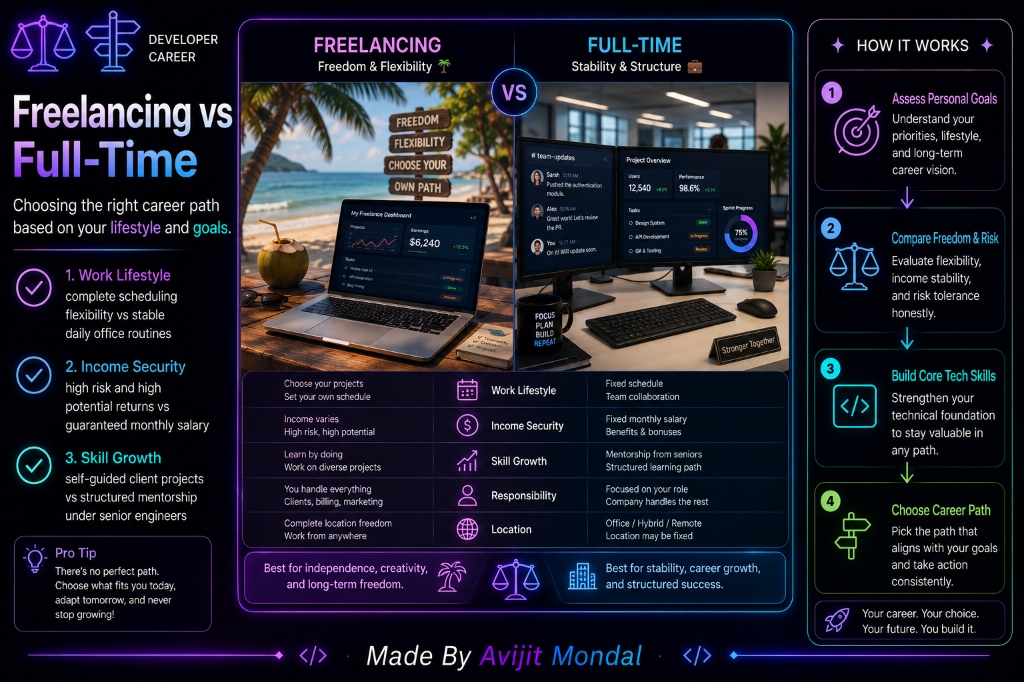
Introduction: Once you learn how to code and build mobile applications, you will face a major career decision: How do you want to work? Do you want to build a career as a **Freelancer** (running your own business, finding clients, and working independently) or take a **Full-Time Job** as an employee at a stable company? Both paths offer incredible benefits, but they fit completely different lifestyles. Let's compare them directly to help you choose the right path.
The Analogy: The Wild Hunter vs. The Village Farmer
Imagine how you secure your food and resource supplies:
- The Freelancer (The Wild Hunter): You explore the forest independently. If you hunt successfully, you bring home a massive feast (high client payments). If you find nothing, you go hungry. You have total freedom to hunt whenever and wherever you want, but you carry all the risk.
- The Full-Time Developer (The Village Farmer): You work in the village farm every day from sunrise to sunset. The village chief pays you a guaranteed, steady bag of grain (monthly salary) every single month, whether the harvest was great or dry. It is stable and safe, but you must work the farm's fixed hours.
Freelancing is like hunting—it offers freedom and high returns but lacks safety. A full-time job is like farming—it provides safety and routines but has a set limit on return.
Pros and Cons of Freelancing
Freelancing means you are not just a coder; you are a business owner. You handle sales, contracts, project design, and tax billing:
- Advantages: You choose your own hours, work from any location, select projects that interest you, and there is no ceiling on how much money you can earn.
- Disadvantages: Your monthly income is unpredictable, you must pay for your own health insurance and equipment, and you must spend unpaid hours marketing yourself to find new clients.
Pros and Cons of a Full-Time Job
A full-time job means you are part of an organization. You have a boss, a team, and a set schedule:
- Advantages: You get a guaranteed salary check every month, paid sick days and holidays, access to senior mentors, and you can focus 100% of your time on writing code rather than finding clients.
- Disadvantages: You must follow fixed schedules and locations, you have little say in what features or projects you work on, and your income increases slowly through set annual raises.
Freelancing vs. Full-Time Job
Here is a quick overview of how these two career directions differ:
| Aspect | Freelancing (Independent Contractor) | Full-Time Job (Company Employee) |
|---|---|---|
| Income Stability | Variable (fluctuates month-to-month) | ✅ Guaranteed (fixed monthly paycheck) |
| Work Schedule | Flexible (you choose your own hours) | Fixed (standard 9-to-5 or core hours) |
| Daily Work | Coding + Sales + Marketing + Accounting | ✅ Coding + Team Meetings |
| Health & Benefits | Self-funded (you pay for everything) | ✅ Covered by company (pensions, dental, holidays) |
| Skill Growth | Self-taught through client projects | ✅ Guided by senior engineer mentors |
Summary
Choosing between freelancing and full-time employment depends on your personal values. If you value flexibility, travel, and business ownership, freelancing is an excellent fit. If you prefer financial predictability, stable career progression, and working in close engineering teams, a full-time position is ideal. You can also start full-time and move to freelancing as your skills mature!