
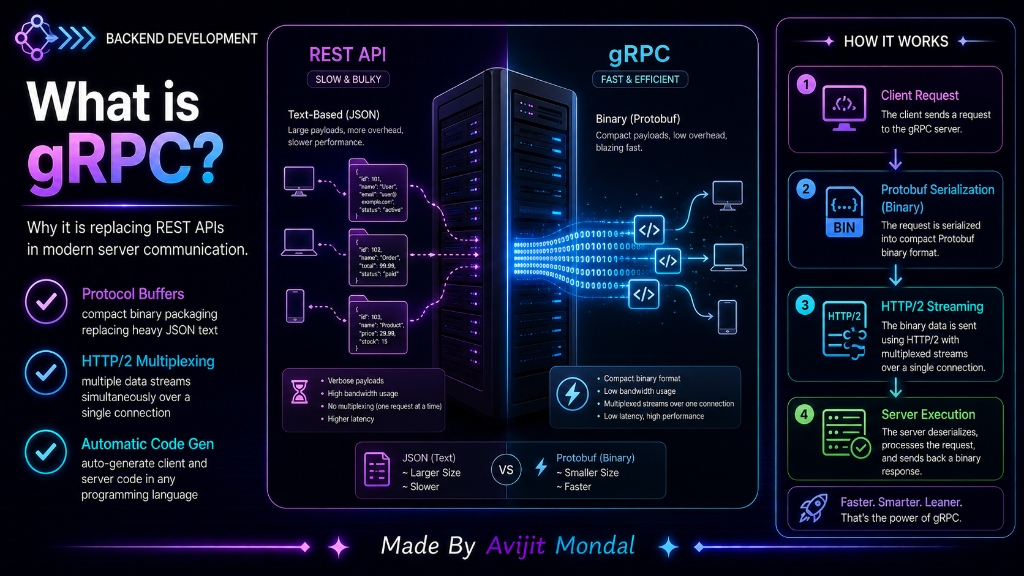
Introduction: Every mobile app needs to talk to a server to load data—whether it is loading your chat messages, refreshing your social feed, or updating a bank balance. For years, REST APIs using JSON text were the default way to do this. But as apps require more speed and real-time updates, a new communication system called gRPC is taking over. Let's look at what gRPC is and why it is replacing REST in modern apps.
The Analogy: The Handwritten Letter vs. The Custom Pneumatic Tube
Imagine ordering items from a warehouse supplier:
- REST API (The Handwritten Letter): Every time you need items, you write a letter in English (JSON text): 'Please send me 3 boxes of apples, 2 crates of oranges.' You fold it, put it in an envelope, and send it. It is very easy for a human to read, but folding, shipping, opening, and reading takes time and uses lots of paper.
- gRPC (The Custom Pneumatic Tube): You use a tube system. Instead of writing letters, you place custom-shaped colored blocks into the tube. A red block means 'apples', and a green block means 'oranges'. The machine at the other end reads the block shapes instantly without opening envelopes or reading words. It is incredibly fast, small, and optimized for speed.
REST is like human letters (JSON text), while gRPC is like machine blocks (Protobuf binary data).
What makes gRPC so fast?
Developed by Google, **gRPC** stands for Google Remote Procedure Call. It replaces the slow parts of REST with two modern technologies:
- Protocol Buffers (Protobuf): Instead of sending data as readable text like JSON, gRPC packages your data into a compressed binary format (1s and 0s). This makes the payload up to 10 times smaller, saving internet data and speed.
- HTTP/2 Protocol: Traditional REST uses HTTP/1.1, where your app has to open a new connection for almost every single image or text file it requests. HTTP/2 allows gRPC to send multiple requests and responses at the same time over a single connection, reducing network lag.
REST APIs vs. gRPC
Here is a comparison of how traditional REST APIs match up against modern gRPC:
| Feature | REST APIs | gRPC (Google RPC) |
|---|---|---|
| Data Format | JSON (Plain Text) | 🤖 Protobuf (Binary Data) |
| Protocol Used | HTTP/1.1 (Single connection request) | 🤖 HTTP/2 (Multiplexed streaming) |
| Payload Size | Large (Text overhead) | 🤖 Tiny (Highly compressed binary) |
| Code Generation | Manual (you must map JSON to objects) | 🤖 Automatic (compiler generates Swift/Kotlin code) |
| Real-Time Streaming | Difficult (requires WebSockets setups) | 🤖 Built-in (bi-directional streaming) |
Summary
gRPC is replacing REST APIs in modern mobile and server architectures due to its extreme efficiency. By using Protocol Buffers (Protobuf) to compress data into tiny binary formats and running over HTTP/2 to stream multiple datasets simultaneously, gRPC can load app screens up to 10 times faster than REST. It is the gold standard for high-performance mobile-to-server communication and microservices!