
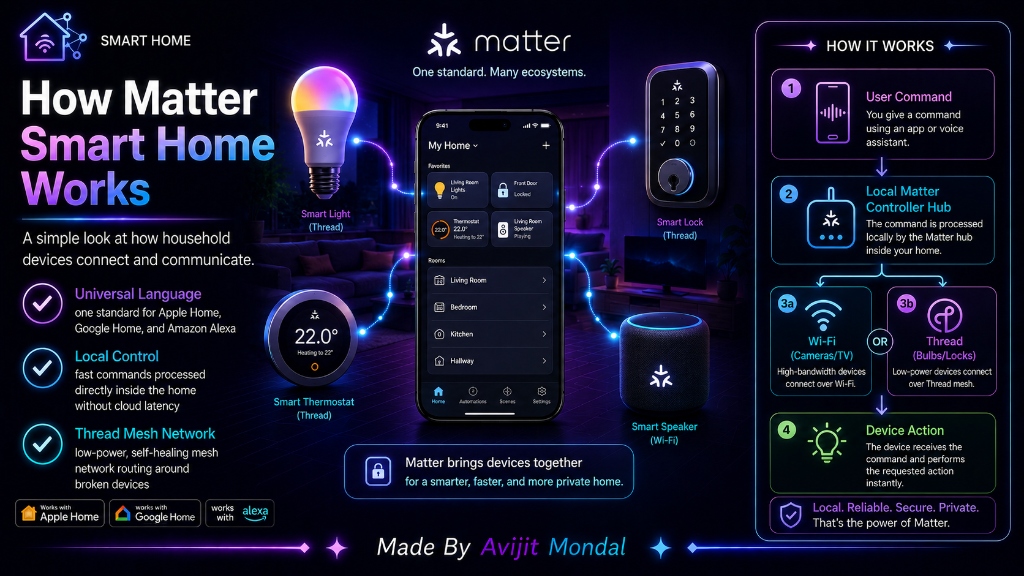
Introduction: For a long time, building a smart home felt like solving a complicated puzzle. You had to carefully check every box at the store to make sure the light bulb or smart plug worked with your specific system—whether that was Apple HomeKit, Google Home, or Amazon Alexa. In 2026, a new smart home standard called Matter has solved this problem. Let's look at how Matter works and why it makes smart home tech easy for everyone.
The Analogy: The Universal Translator for Household Devices
Imagine a kitchen team preparing a big dinner, but they all speak different languages:
- The Old Smart Home: The chef speaks French (Apple), the sous-chef speaks Spanish (Google), and the pastry chef speaks Chinese (Amazon). Because they cannot communicate, they work in separate corners, cooking separate dishes. You need to hire three translators just to coordinate a simple meal.
- The Matter Way: The restaurant manager makes a simple rule: 'From now on, everyone in this kitchen speaks English (Matter).' Instantly, the chef can tell the sous-chef to chop onions, and the pastry chef knows exactly when to bake the bread. They work together seamlessly as one team.
Matter acts as that universal language, allowing different brands of smart home devices to talk directly to each other.
What is the Matter Protocol?
**Matter** is a new smart home connectivity standard created by a collaboration of major technology companies, including Apple, Google, Amazon, and Samsung. Instead of building different communication systems for every device, manufacturers build one Matter-compliant product. Any smart speaker, phone, or tablet running any major operating system can control it.
How Matter Connects Your Devices
Matter does not replace Wi-Fi or Bluetooth; it sits on top of them and works using two main methods:
- Wi-Fi: High-bandwidth devices like smart security cameras, video doorbells, and TV systems connect via your home Wi-Fi network.
- Thread: Small, low-power devices like smart plugs, light switches, and door sensors use a newer technology called Thread. Thread creates a self-healing mesh network, where each device acts as a mini-router, passing signals to the next device. If one bulb fails, the signal automatically routes around it.
Smart Home: The Old Way vs. The Matter Way
Here is a comparison of how smart homes have evolved with the Matter standard:
| Feature | The Old Smart Home (Before Matter) | The Modern Smart Home (With Matter) |
|---|---|---|
| Device Compatibility | Locked into Apple, Google, or Amazon ecosystems | ✅ Works with all ecosystems simultaneously |
| Setup Process | Each brand needs its own custom app and login | ✅ Scan a single QR code to connect instantly |
| Internet Dependency | Commands travel to the cloud and back (adds lag) | ✅ Local connection over Wi-Fi/Thread (almost zero lag) |
| Hardware Bridges | Every brand requires a separate bridge hub | ✅ One single Matter hub controls all devices |
Summary
The Matter protocol has unified the smart home industry by introducing a shared language for smart devices. By allowing products from Apple, Google, and Amazon to communicate directly over local Wi-Fi and low-power Thread mesh networks, Matter eliminates brand lock-in, increases response speeds, and ensures your smart home keeps working even when offline. Building a smart home is now as simple as scanning a code!