Introduction: Preparing for your first mobile developer interview can feel overwhelming. You are expected to demonstrate that you can write clean code, explain complex platform concepts (like memory management, background tasks, or threading), and prove that you are a collaborative teammate. Let's break down the interview preparation process into three simple, actionable areas to help you succeed.
The Analogy: The Driving License Test
Think of a mobile developer interview like taking a test to get your driver's license:
- The Theory Test (Technical Questions): You must show that you know the rules of the road—such as what a view controller lifecycle is, how the operating system manages memory, and how threading keeps screens fast.
- The Driving Test (Live Coding): The instructor sits next to you to see how you steer, park, and check mirrors. Similarly, the interviewer watches how you type code, structure variables, and debug errors.
- The Personality Check (Behavioral Checks): The examiner checks if you are calm, follow directions, and communicate clearly under pressure.
To pass, you must prepare for all three aspects of the test, not just the coding part.
The 3 Pillars of Mobile Interview Prep
Organize your study routine around these three core interview components:
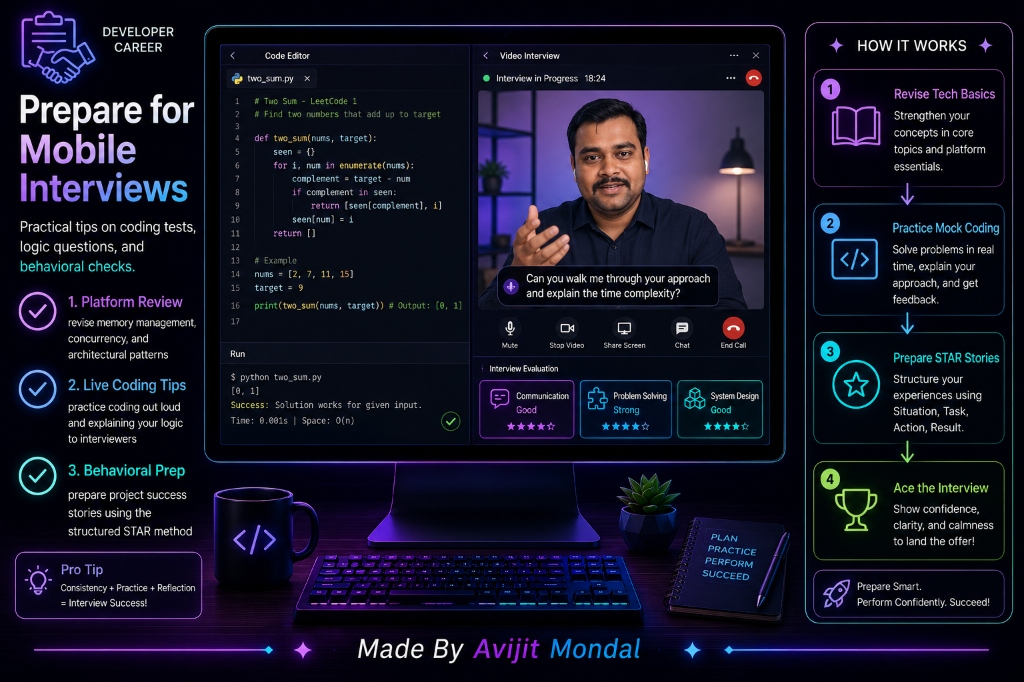
- 1. Platform Fundamentals: Review core concepts for your platform. iOS developers should study Optionals, ARC memory management, SwiftUI vs. UIKit, and GCD/Concurrency. Android developers should study Coroutines, Activities/Fragments, ViewModel, and Room database.
- 2. Coding Practice (Talk Out Loud!): Practice basic coding challenges (like reversing a list, checking strings, or building simple API screens). The most important tip during coding is to talk out loud. Explain *why* you are writing a loop or using a specific variable so the interviewer can follow your thought process.
- 3. Behavioral Stories (STAR Method): Prepare 3 stories about past projects. Describe them using the STAR method: Situation (the context), Task (your goal), Action (what you coded/resolved), and Result (the successful outcome).
What Interviewers Look For
Here is what companies evaluate depending on your target experience level:
| Evaluation Area | Junior Developer Candidates | Senior Developer Candidates |
|---|---|---|
| Coding Ability | Writes working, basic code; understands loops and logic | ⭐ Writes clean, structured, and modular code with test cases |
| Architecture | Understands basic MVC/MVVM patterns | ⭐ Designs scalable, testable systems using Clean Architecture |
| Problem Solving | Open to taking hints and suggestions when stuck | ⭐ Solves complex bugs independently and thinks of edge cases |
| Teamwork | Eager to learn, open to feedback, good listener | ⭐ Mentors juniors, leads discussions, reviews code patterns |
Summary
Succeeding in a mobile developer interview requires balancing three elements: platform technical fundamentals, clear live-coding logic with vocal explanations, and structured stories about your project achievements using the STAR method. Presenting your code clearly and maintaining a collaborative, teachable attitude is the key to landing your first mobile developer job!