Introduction: For over two decades, searching the internet meant typing keywords into a search box and getting a page full of blue links. We had to click each link, read the pages, and assemble the answer ourselves. Today, a new wave of AI search engines like Gemini, ChatGPT Search, and Perplexity are changing that. Instead of showing you where the answers might be, they read the web for you and give you a direct, summarized answer.
The Analogy: The Library Index vs. The Personal Research Assistant
To understand how AI search engines differ from traditional search, imagine walking into a massive library:
- Traditional Search (The Library Index): You ask for information on 'how photosynthesis works'. The librarian hands you a list of 10 books. You have to find the books on the shelves, open them, read different chapters, and summarize the process yourself.
- AI Search (The Personal Research Assistant): You ask the same question. The research assistant runs to the shelves, opens 5 different books, reads them, and walks back to you to explain photosynthesis in a short, easy-to-understand summary. They even tell you which books they got the information from!
AI search engines act like that personal research assistant. They do the reading and organizing for you, saving you time and effort.
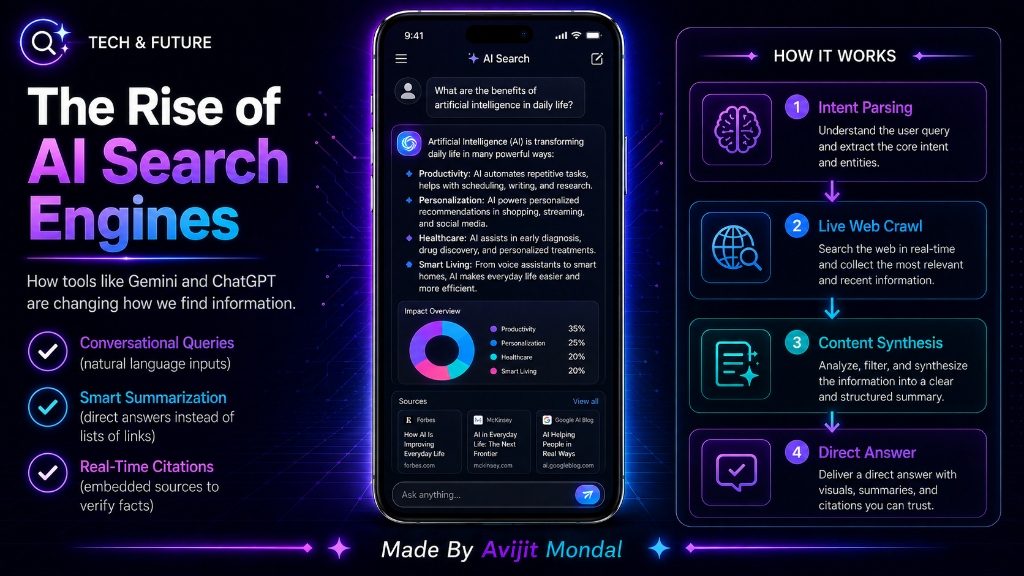
How AI Search Engines Work in 4 Simple Steps
When you type a query into an AI search engine, it goes through a quick, automated process before replying:
- 1. Reading the Intent: The AI figures out what you are looking for, even if you ask in normal, conversational English instead of strict keywords.
- 2. Web Retrieval: It runs search queries in the background to find high-quality, up-to-date web pages related to your topic.
- 3. Reading and Synthesizing: The AI reads the content of these pages, filters out ads or spam, and extracts the core facts.
- 4. Draft and Cite: It writes a custom response combining those facts and adds clickable links (citations) so you can verify where each piece of information came from.
Traditional Search vs. AI Search
Here is how traditional keyword-based search compares to modern conversational AI search:
| Feature | Traditional Search (Google, Bing) | AI Search (Gemini, ChatGPT Search) |
|---|---|---|
| Output Format | List of website links and snippet text | ✅ A complete, written paragraph or list |
| Multiple Sources | You must open multiple tabs to compare | ✅ AI reads and merges multiple sources |
| Conversation | You have to start a new search for follow-ups | ✅ You can chat and ask follow-up questions |
| Best Used For | Navigating to websites, local listings, shopping | ✅ Learning concepts, coding help, complex research |
Summary
AI search engines like Gemini and ChatGPT are shifting the web from 'search and read' to 'ask and receive'. By reading multiple web pages, summarizing the main points, and citing their sources in a chat interface, they act as personal research assistants. While traditional search remains useful for navigating to specific sites, AI search makes learning new topics and finding complex answers much faster!