
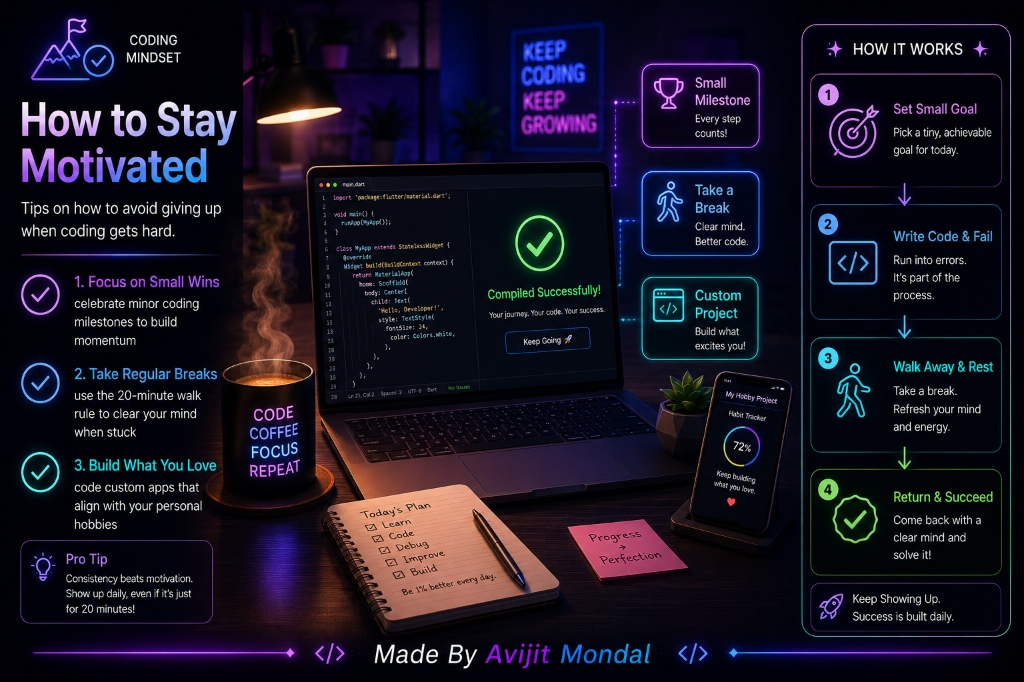
Introduction: Learning to code is an incredibly rewarding journey, but it is also one of the most mentally challenging skills to learn. On Monday, you might feel like a genius because your code compiles and prints a message. On Tuesday, you might feel like an imposter because a missing bracket has broken your entire project. If you are feeling stuck or overwhelmed, know that this is normal. Let's look at practical tips to keep you motivated and moving forward when learning gets tough.
The Analogy: Learning to Play the Piano
Think of learning programming like learning to play the piano:
- On your first day, you want to play a beautiful, complex symphony. Instead, your instructor makes you play repetitive scales, and your fingertips ache.
- If you constantly compare your clumsy scales to a professional concert pianist (a senior developer), you will get discouraged and lock the piano.
- But if you celebrate playing a simple children's song without missing a note (writing your first small loop), you build confidence and want to keep practicing.
Coding is a physical and mental practice. Celebrate your nursery rhymes—they are the stepping stones to building complete applications.
5 Rules to Avoid Giving Up
Implement these simple guidelines to maintain study consistency and protect your mental energy:
- 1. Focus on Small Wins: Do not try to build a massive social network on your first week. Celebrate printing a line of text, changing a button's background color, or adding two variables. Small wins build momentum.
- 2. The 20-Minute Walk Rule: If you are stuck on a compiler bug for more than 20 minutes, close your laptop. Walk away, drink water, or take a nap. Your brain will continue solving the problem in the background, and the fix will often look obvious when you return.
- 3. Build Projects You Love: Do not just copy dry code from video courses. If you are a sports fan, build a basic scoreboard app. If you like cooking, build a recipe list app. You will push through coding blocks much more easily when you want to use the final app.
- 4. Stop Comparing Yourself to Experts: Senior developers have spent thousands of hours typing, failing, and reading documentation. Comparing your Day 10 to their Year 10 is unfair. Only measure your progress against your yesterday self.
- 5. Treat Bugs as Learning Steps: Every time your code crashes, you have a chance to learn. Finding and solving bugs is where real programming happens, not when you type code that compiles instantly.
Tutorial Hell vs. Active Building
Compare passive learning with active building to see how you should spend your coding hours:
| Aspect | Tutorial Hell (Passive) | Active Building (Independent) |
|---|---|---|
| What you do | Watch hours of videos without typing | ⌨️ Build a custom app, make mistakes, and fix them |
| Mental Ease | High (feels comfortable and safe) | 🔥 Challenging (requires thinking and research) |
| Skill Retention | Low (you forget concepts instantly) | ✅ High (errors make your brain remember solutions) |
| Motivation Level | Low (gets boring very quickly) | ✅ High (exciting to see your own app work) |
Summary
Staying motivated while learning to code is about managing your expectations and study habits. By focusing on small milestones, taking regular breaks when stuck, building custom projects that excite you, avoiding comparisons to expert developers, and actively practicing rather than passively watching tutorials, you can build a sustainable, rewarding programming habit!